
RIS CUTTING EDGE FOURM

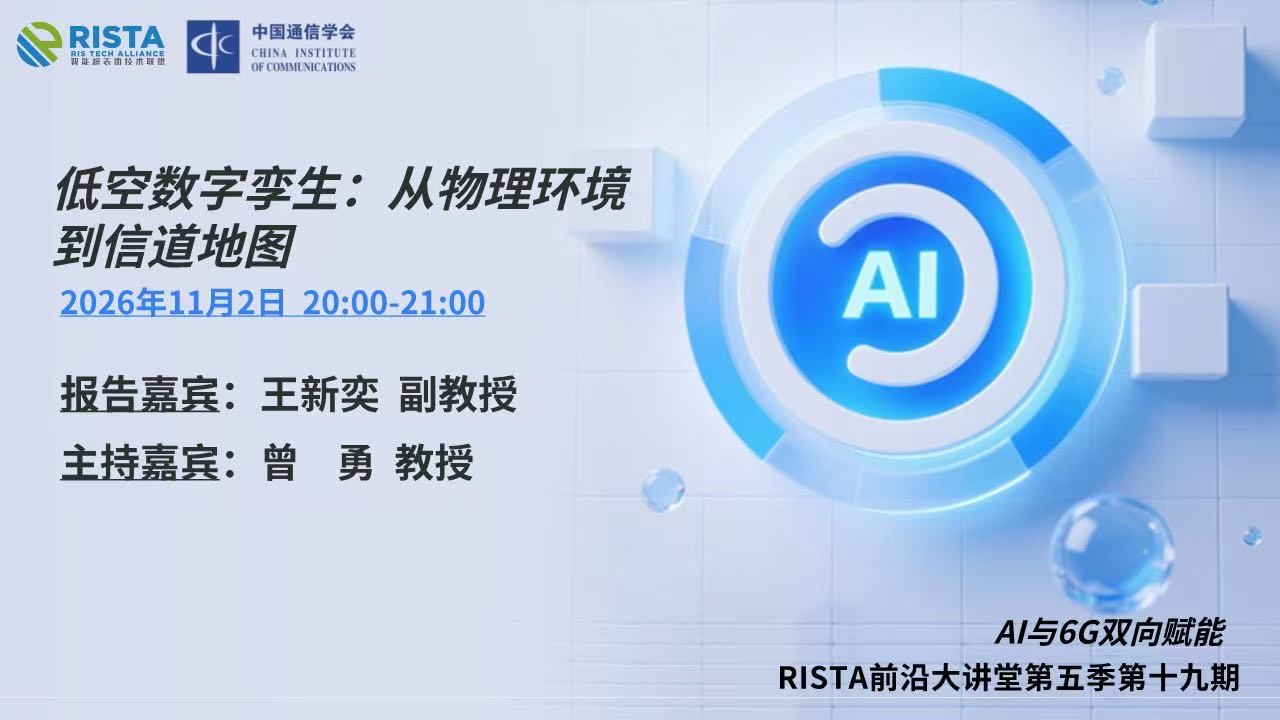
Low-Altitude Digital Twins: From Physical Environments to Channel Knowledge Maps

低空数字孪生:从物理环境到信道地图

Low-Altitude Digital Twins: From Physical Environments to Channel Knowledge Maps

Low-altitude information networks face significant challenges arising from uncertain physical environments, rapidly time-varying wireless channels, and complex network optimization and decision-making. To address these challenges, this talk presents the construction and applications of low-altitude digital twins along two complementary research directions: physical environment digital twins and channel knowledge map (CKM) digital twins. For physical environment digital twins, we introduce continuous sensing-driven environment perception and updating, embodied intelligence-enhanced UAV trajectory optimization, and digital twin-assisted virtual training and safety-aware decision-making. For CKM digital twins, we present environment-aware approaches for constructing three-dimensional CKMs, interference-aware CKMs, and differentiable CKMs. We further discuss their applications in UAV trajectory optimization, intelligent beam management, continuous beamforming, and multi-base-station cooperative handover. These studies provide technical foundations for predictive network optimization and autonomous decision-making in low-altitude information networks.

Xinyi Wang is an Associate Professor and Doctoral Supervisor at the School of Information and Electronics, Beijing Institute of Technology. His research interests include integrated sensing and communication (ISAC), low-altitude information networks, and short-range wireless communications. He is one of the founding members of the IEEE ComSoc Technical Committee on Low-Altitude Wireless Networks. He has published over 100 academic papers, including more than 30 SCI-indexed journal papers as the first or corresponding author and two ESI Highly Cited Papers. His publications have received over 2,700 citations on Google Scholar. He has served as the principal investigator of several national and provincial/ministerial-level research projects and as a key contributor to multiple National Science and Technology Major Projects of China. He has received several academic awards and honors, including the Second Prize of the Natural Science Award from the China Institute of Communications, the Outstanding Doctoral Dissertation Nomination Award from the Chinese Institute of Electronics Education, and the Outstanding Paper Award and Most Influential Paper Award from the Journal of Electronics & Information Technology.